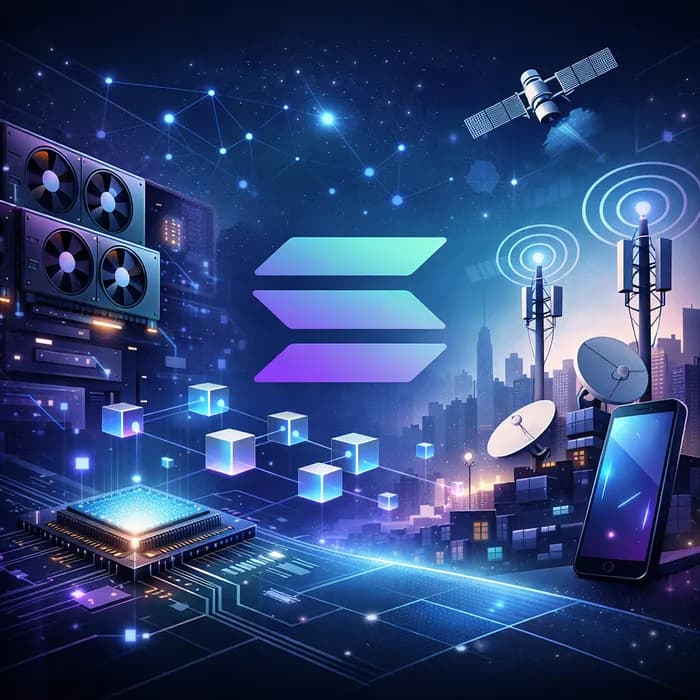
Solana’s DePIN Renaissance: Inside the GPU & Mobile Network Boom
An in-depth analysis of how Solana has become the backbone for Decentralized Physical Infrastructure Networks, focusing on the explosion of GPU compute and wireless protocols like Render, io.net, and Helium.
While the broader crypto market remains fixated on institutional capital flows and ETF approvals, a more tangible revolution is taking place on the Solana blockchain. Decentralized Physical Infrastructure Networks (DePIN) represent a fundamental shift in how blockchain technology interacts with the real world, moving beyond digital speculation to the coordination of physical hardware. By leveraging Solana’s high-throughput architecture, protocols are successfully bridging the gap between Web3 infrastructure and real-world utility, creating a renaissance in distributed GPU computing and decentralized wireless networks.
The Shift to Solana: Why DePIN Found a Home Here
The migration of major DePIN projects to Solana is a strategic calculation based on unit economics. DePIN projects require the coordination of millions of physical devices—from sensors to GPUs—reporting data on-chain in near real-time. This necessitates a blockchain capable of handling massive transaction volumes with negligible fees.
Solana’s monolithic architecture offers a distinct advantage. The introduction of State Compression has been a game-changer, allowing projects to mint Compressed NFTs (cNFTs) to represent physical hardware at a fraction of the cost found on EVM chains. For instance, Helium’s migration involved minting nearly 1 million hotspots as NFTs—a feat that would have been cost-prohibitive elsewhere. This allows for the granular tracking of tokenized assets without bloating the network.
The AI-Driven Surge: Distributed GPU Compute
As the AI boom creates an insatiable demand for computing power, centralized providers like AWS are struggling with supply shocks. This has created a perfect storm for Distributed GPU Compute networks on Solana, most notably Render (RNDR) and io.net (IO).
Render Network (RNDR)
Render transitioned to Solana to unlock real-time streaming and faster settlement. By connecting artists needing rendering power with idle GPU owners, Render utilizes Solana to process dynamic job states faster, creating a decentralized alternative to traditional render farms.
io.net (IO)
io.net aggregates GPU supply from independent data centers and crypto miners to create clusters for training ML models. Its integration with Solana allows for transparent, on-chain proof-of-compute, ensuring hardware providers are paid accurately for the specific 'compute units' they contribute.
Connectivity 2.0: Helium Mobile and the SOL Ecosystem
Helium’s move to Solana revitalized the project, leading to the $20/month unlimited plan in the US. Helium Mobile leverages 'Discovery Mapping,' rewarding users in MOBILE tokens for sharing location data to verify coverage. The speed of Solana ensures these micro-rewards are distributed daily to thousands of users without congestion, proving the ecosystem can handle consumer-scale applications.
The Economic Flywheel: Real Yield vs. Speculation
This convergence of hardware and software is driving a transition from speculative tokenomics to 'Real Yield.' Unlike governance tokens with no value capture, successful DePIN protocols generate revenue from external customers:
- Render: 3D artists pay for rendering scenes.
- Helium: Subscribers pay monthly fiat fees.
- io.net: AI researchers pay for compute time.
This revenue creates buy-pressure for the native tokens or the underlying SOL needed for network usage. When physical utility drives on-chain demand, it creates a floor for valuation based on actual usage revenue rather than hype.

Scaling and Risks: Monolithic vs. Modular
Solana’s monolithic approach simplifies composability but is not without risks. Centralized validator requirements and potential outages remain concerns for enterprise-grade infrastructure. However, the upcoming Firedancer validator client aims to boost throughput to over 1 million transactions per second. If successful, it could cement Solana’s monopoly on DePIN by offering bandwidth that modular L2s cannot match without fragmenting liquidity.
Conclusion
Solana’s DePIN renaissance is a validation of blockchain’s utility in the physical world. By offering speed, low costs, and state compression, Solana has become the de facto execution layer for distributed infrastructure. For investors, protocols like Render and Helium offer exposure to a sector where value is derived from physical utility. As the network matures, the ability to coordinate real-world assets on-chain may become Solana's most enduring legacy.
Disclaimer: This article is for educational purposes only and does not constitute financial advice.