Stablecoins as RWA Fuel: The $2T On‑Chain Finance Flywheel
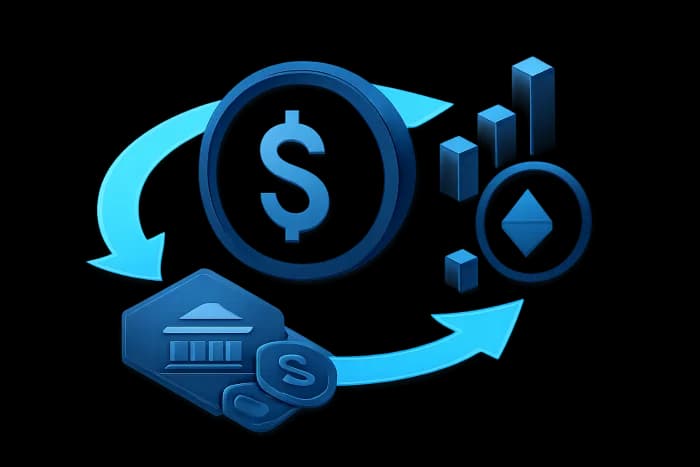
Stablecoins are the plumbing that turned tokenized RWAs from pilots into investible collateral; Standard Chartered’s recent $2T by 2028 projection shows how a stablecoin‑led flywheel can deepen on‑chain dollar liquidity, anchor tokenized treasuries and credit (e.g., ONDO), and attract institutional capital—if regulation, custody rails, attestations, and secondary markets mature.
Title: Stablecoins as RWA Fuel: The $2T On‑Chain Finance Flywheel
Introduction
What if the dollar's next structural expansion happens not in bank vaults but in smart contracts? That thesis underpins the recent surge in tokenized real-world assets (RWAs). The conduit for this expansion is stablecoins—instantly transferable dollar liquidity on-chain—which enable tokenized treasuries and private-credit instruments to serve as collateral inside DeFi. Standard Chartered projects tokenized RWAs could reach roughly $2 trillion by 2028. That raises two investor questions this post answers: what must go right for the flywheel to spin, and where should conservative, moderate, and aggressive investors allocate today? Brief roadmap: first the mechanism and data, then a case study, scaling considerations, prerequisites and risks, and finally practical allocations and due diligence steps.
How stablecoins power tokenization and the RWA flywheel
The mechanism is straightforward. Stablecoins (USDC, USDT, and newer institutional designs) provide the on-chain dollar base. That liquidity enables markets for tokenized money-market products and short-duration treasuries—institutions-grade yield instruments that can be posted as collateral in lending markets. More on-chain dollars mean deeper RWA markets, which in turn attract more institutional demand for stablecoin rails: a self-reinforcing loop.
This bootstrap role is visible in the numbers. As of Nov 8, 2025, RWA.xyz reports on-chain RWAs of roughly $35.8B versus total stablecoin value of ≈ $295B—an imbalance that stablecoins can help close as tokenization scales.
Case study: Ondo Finance and tokenized treasuries
Ondo Finance (ONDO) offers a clear example of the flywheel in action. Its treasury-backed tokens (for example, OUSG and USDY) are being listed on regulated venues and integrated into DeFi rails, allowing market participants to mint, swap, and use tokenized treasuries as collateral across chains. Listings on regulated venues and custody integrations (e.g., Assetera’s listing of OUSG) demonstrate the custody and trading rails institutional counterparties expect.
Why this matters: tokenized treasuries provide a low-risk yield anchor for stablecoin reserve managers and DeFi lenders. When these instruments are easily transferable on chains like Ethereum and its L2s, they reduce friction for banks, hedge funds, and treasury desks interacting with on-chain liquidity—supporting more frequent rebalances and programmatic redemptions.
Ethereum L2s, settlement costs, and how they multiply the flywheel
Technical scaling materially affects feasibility. The post-Dencun environment (including EIP-4844 and blob-carrying data formats) and rapid L2 adoption have driven large declines in per-transaction settlement costs on rollups. That cost compression makes frequent treasury rebalances, atomic settlement, and programmatic redemptions practical for institutional flows—lowering a key barrier to on-chain custody and trading of RWAs and stablecoin-backed products.
What needs to go right for $2T by 2028
Four broad prerequisites stand out:
-
Regulatory clarity and permissive market structure — Issuers, custodians, and trading venues need clear rules for issuance, KYC/AML, investor eligibility, and whether regulated entities can custody tokenized securities. U.S. regulatory clarity is often cited as a gating item.
-
Bank-grade custody and settlement rails — Qualified custodians and settlement utilities must integrate token custody, support redemption flows, and enable institutional settlement lifecycles (T+0/T+1). Current pilots point in this direction but broad-scale integration is required.
-
Transparent, auditable attestations and oracle infrastructure — Reliable proofs-of-reserve (PoR), NAV reporting, and real-time pricing are essential. Oracles and PoR tooling must become more decentralized, auditable, and timely.
-
Secondary-market liquidity and market-making — Tokenized assets must trade with tight spreads so collateral can be rehypothecated or liquidated reliably. This requires market-making, venue integration, and regulatory permissioning for both retail and institutional participants.
If these conditions are met, the flywheel runs: sustained stablecoin supply supports RWA issuance → tokenized RWAs become usable collateral in DeFi → improved yields and credit access attract institutions → institutions demand more stablecoin rails and tokenized products.
Investor risk checklist
- Issuer concentration: A small number of large stablecoin issuers and RWA managers can create central points of failure—monitor reserve composition and issuer governance.
- Oracle and attestation design: Weak price feeds or PoR mechanisms can trigger on-chain liquidation cascades—assess decentralization and refresh cadence.
- Basis risk (on-chain vs off-chain): Tokenized instruments may not track off-chain equivalents 1:1 if liquidity, redemption mechanics, or legal claims differ—stress-test redemption paths.
- Legal and custody risk: Token holders’ rights vary by jurisdiction—favor clear legal wrappers and regulated custodians.
- Operational and counterparty risk: Settlement rails, transfer-agent integrations, and custodial key management are attack surfaces; on-chain security is necessary but not sufficient.
Recent security reporting in 2025 highlights operational incidents—continuous monitoring and security tooling are essential.
Practical investor map: where to plug in today (conservative → aggressive)
Conservative (capital preservation and dollar liquidity):
- Short-duration tokenized treasury products from regulated issuers with custodial support (e.g., institutional OUSG-style tokens). Use audited venues and top-tier custodians.
- Liquidity layer: Hold high-quality, fully backed USDC on regulated custodial rails for settlement and yield via insured or low-risk products.
Moderate (yield and liquidity):
- Diversified exposure to tokenized MMFs and vaults that combine stablecoins and tokenized treasuries. Prioritize transparent NAVs and third-party attestations.
- Participate in regulated secondary venues and AMM pools that list tokenized treasuries to capture spreads and provide liquidity.
Aggressive (alpha and composability):
- Use DeFi credit stacks that accept tokenized RWAs as collateral—exercise caution around liquidation parameters.
- Take concentrated exposure to leading RWA infrastructure or protocol tokens that capture custody, settlement, and tokenization fees—only after thorough due diligence.
Actionable due diligence steps
- Check reserve composition and proof-of-reserve cadence for any stablecoin exposure.
- Confirm custodial counterparties and legal wrappers for tokenized assets (offering documents, transfer-agent arrangements).
- Review oracle design (multi-feed inputs, fallback logic, refresh rate) and examine on-chain historical stress tests.
- Monitor secondary-market depth and realized spreads where the token trades.
Conclusion
The $2 trillion projection for tokenized RWAs by 2028 is ambitious but a useful scenario. The flywheel is already visible: stablecoin supply and wallet counts dwarf current on-chain RWA stock, L2 cost declines make frequent settlement economical, and firms such as Ondo are building treasury-grade products. The gap between theory and scale is execution: regulators, custodians, oracles, and venue liquidity must evolve together. Investors who understand and actively monitor these operational and legal levers will be best placed to capture the opportunity while managing concentrated and systemic risks.
Sources
- Standard Chartered, Tokenized RWAs forecast (Nov 1, 2025). [CoinCentral summary]
- RWA.xyz live dashboard (snapshot 2025-11-08)
- Assetera press release (Listing of OUSG, Feb 20, 2025) and related RWA coverage (Oct–Nov 2025)
- Technical and market coverage of Ethereum upgrades and L2 fee compression (Sep–Oct 2025)
- RWA security reporting and Veritas report (Oct 25, 2025)
(For a live snapshot of on-chain RWA totals and the stablecoin base cited above, see RWA.xyz's dashboard.)