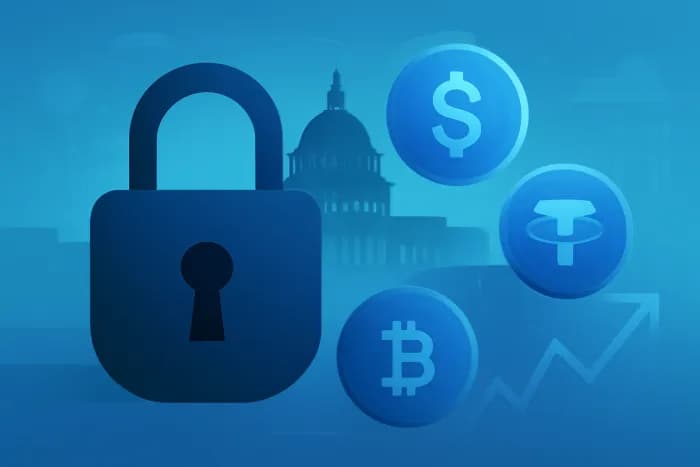
Shutdown whiplash: stablecoin bill timelines traders must watch
A federal shutdown that began Oct 1, 2025 has paused committee markups and squeezed agency capacity just as stablecoin and market‑structure laws were moving. This post maps three realistic legislative paths, translates each into concrete risks and opportunities for USDC/USDT issuers, exchanges and DeFi, and gives a week‑by‑week monitoring and hedging toolkit traders can use to manage policy risk.
Title: Shutdown whiplash: stablecoin bill timelines traders must watch
Introduction
A funding lapse on Oct. 1, 2025 has put two of crypto’s biggest policy questions — a stablecoin regulatory framework and market‑structure rules — into limbo. That pause matters for traders because stablecoins are the plumbing for dollar liquidity: short interruptions or sudden rule changes that affect issuance, reserve composition, or supervision can reprice counterparty and liquidity risk within hours. Below is a practical playbook: three realistic legislative outcomes, what each would mean for USDC/USDT issuers and venues, a week‑by‑week monitoring checklist, and concrete hedging ideas traders can use now. Sources are cited inline.
How a shutdown translates into "whiplash"
A funding lapse typically slows or halts committee markups, delays staff work and agency reviews, and forces some regulators onto skeleton operation—reducing the capacity for new rule filings or rescinding planned guidance. That creates two possible dynamics: paralysis (timelines slip and uncertainty drags on) or sprint (when appropriations resume, policy can move rapidly). The three scenarios below map those dynamics and the most likely market responses.
Three paths for crypto legislation — what to expect (and why it matters)
- Fast‑track compromise (best case)
- Timeline: Congress reopens and leaders prioritize a narrowly worded stablecoin/market‑structure package; the bill reaches the president within roughly 6–12 weeks if leadership bundles it into a must‑pass vehicle. (Context: Senate passed related language earlier this year and companion measures moved in the House.) (Blockworks, Oct. 2, 2025).
- Immediate market reaction (hours–weeks): Certainty compresses risk premia; USDC tightens basis vs. USD, and exchanges accelerate product launches.
- Medium-term effect (months): Faster bank integrations and product rollouts; custody providers and banks that plan token issuance are short-term winners (Fed speech on stablecoins, Oct. 16, 2025).
- Agency guidance and incremental rulemaking (medium case)
- Timeline: Congress stalls but agencies (Treasury, Fed, SEC, CFTC, OCC) issue guidance or interim rules to fill key gaps. Agencies can often continue essential interpretive work despite funding uncertainty.
- Immediate market reaction: Partial certainty reduces some tail fears but enforcement and requirements are uneven across players.
- Medium-term effect: Increased supervisory expectations (reserve composition, disclosure cadence); larger issuers with transparent reserves gain market share while smaller issuers face higher compliance costs (CoinDesk, Sept. 27, 2025).
- Prolonged stalemate into 2026 (worst case)
- Timeline: Shutdown plus a compressed legislative calendar pushes meaningful bills into 2026 or beyond; previously scheduled Senate markups slip.
- Immediate market reaction: Policy risk remains a persistent tax on volatility; investors may favor venues and corridors perceived as more liquid or less susceptible to regulatory friction.
- Medium-term effect: Increased fragmentation of stablecoin corridors, higher collateral haircuts in DeFi, and structural innovation (tokenized MMFs, cross‑chain routing) as market participants adapt (Cryptonews, Oct. 28, 2025).
What each scenario means — concrete risks & opportunities
USDC (Circle)
- Fast‑track: Accelerated product launches, higher deposits, and a bid for high‑quality reserves (e.g., T‑bills). (Reuters, Jun. 25, 2025.)
- Agency guidance: Expect new disclosure cadence (monthly attestation or similar); transparent issuers are favored by lenders and exchanges.
- Stalemate: Slower balance‑sheet growth, higher compliance/litigation risk, and the need for larger liquidity buffers against redemptions.
- Fast‑track: Continued exchange usage and market‑making share; may face pressure to increase formalized transparency to meet new standards.
- Agency guidance: Onshore regulatory scrutiny could raise operating costs even if business remains largely offshore.
- Stalemate: Status quo persists functionally, but headlines and corridor fragmentation increase counterparty risk premia.
Exchanges and DeFi
- Fast‑track: Easier relistings and lower collateral haircuts for dollar pairs.
- Agency guidance: Outcomes will be uneven; centralized venues adapt faster, while permissionless DeFi may face structural friction if some drafts raise identity or front‑end constraints. (Adjust claims where specific citations are not available.)
- Stalemate: Innovation and cross‑border routing accelerate; tokenized MMFs and yield wrappers gain share.
Signals traders should watch — week by week
Week 0 (immediate)
- Check agency operations and SEC guidance: shutdowns often limit SEC review capacity and slow new ETF/registration reviews. Watch SEC press releases and agency operational notices closely.
Weeks 1–4
- Watch committee calendars and markup schedules (Senate Banking, House Financial Services). Rescheduling is a high‑signal event: a rapid reschedule to an active window often triggers fast repricing.
Ongoing (real‑time metrics to monitor)
- Stablecoin supply flows (USDC vs USDT weekly issuance/net flows). Set a baseline and watch percentage deviations.
- Exchange stablecoin reserves and CEX on‑chain balances.
- On‑chain mint/redemption patterns—large redemptions are an early warning sign (see thresholds below).
- Treasury and Fed commentary for signals on systemic policy views.
Suggested alert thresholds (examples to operationalize)
- Absolute $ weekly net outflow > 5% of circulating supply for a given stablecoin or weekly outflow spike > historical 95th percentile → immediate review.
- Exchange reserve divergence: top 5 exchange combined reserve drop > 10% week‑over‑week → elevated watch.
- On‑chain large redemption or mint (> $50M single tx across chains) → trigger liquidity check (these numbers should be tailored to your book size).
Hedging & positioning frameworks (practical)
Liquidity defense (if you are long risk)
- Reduce leverage where funding uses USDC/USDT as margin; tighten maintenance thresholds.
- Diversify margin collateral across credible dollar sources (USDC, USDT, tokenized MMFs); avoid single‑issuer concentration.
- Maintain a small on‑chain redeemable buffer (e.g., 5–15% of portfolio in redeemable stablecoins off‑exchange).
Tail‑risk hedges (if you trade volatility)
- Buy downside put protection on crypto indices or use futures shorts to hedge directional exposure.
- Use spread trades (short tokens with concentrated stablecoin corridors, long peers) to capture corridor basis moves.
Event/speculative trades
- Fast‑track bet: long custody/exchange equities and long USDC basis (expect tightening premiums).
- Stalemate bet: long cross‑chain bridging and tokenized MMF exposure anticipating demand for alternative dollar liquidity.
Short toolkit — data feeds, bill trackers, and on‑chain metrics to follow
Policy & schedules
- Congress.gov bill tracker (watch progress of the key stablecoin and market‑structure bills).
- Senate Banking Committee and House Financial Services calendars (committee pages).
Market & on‑chain data
- Stablecoin supply & issuance: CoinGecko / CoinMarketCap and weekly research reports.
- On‑chain flows: Whale Alert, block explorers (Etherscan/Tron/Algorand), Nansen, Glassnode.
- DeFi liquidity: DeFiLlama TVL, DEX orderbook snapshots, exchange reserve dashboards.
- Macro & liquidity: Treasury curve and T‑bill demand (see Reuters primer on stablecoin demand for Treasuries).
News & day‑to‑day policy color
- Blockworks, CoinDesk, Cryptonews for policy reporting and schedule moves (use them to validate committee schedule changes and Capitol Hill color).
Closing — what TokenVitals readers should do now
- Operationalize the checklist into line‑item alerts: daily issuance deltas, large net outflows from exchanges, and Senate/House markup reschedules. Set concrete thresholds for each alert.
- Reduce concentration risk: avoid single‑issuer dependency for margin or settlement; diversify collateral sources.
- Size tail hedges modestly: keep protective positions small but in place while committee calendars are compressed and agencies operate with reduced capacity.
Final note
Regulatory risk can flip quickly from paralysis to sprint once appropriations resume. If you prepare a monitored checklist and modest hedges now, the subsequent moves will be tradable when policy activity resumes.
Optional: TokenVitals offering
If you want automated daily signals, TokenVitals can configure a tailored 'shutdown whiplash' feed—USDC/USDT issuance deltas, exchange balance divergence, committee schedule changes, and a risk score mapped to suggested hedge notional. Tell us your preferred risk budget and we'll configure it. (This is an optional paid service.)
Sources (representative) Blockworks (Oct. 2, 2025); CoinDesk (Sept. 27, 2025); Federal Reserve speech (Oct. 16, 2025); Reuters (Jun. 25, 2025); Cryptonews (Oct. 28, 2025).