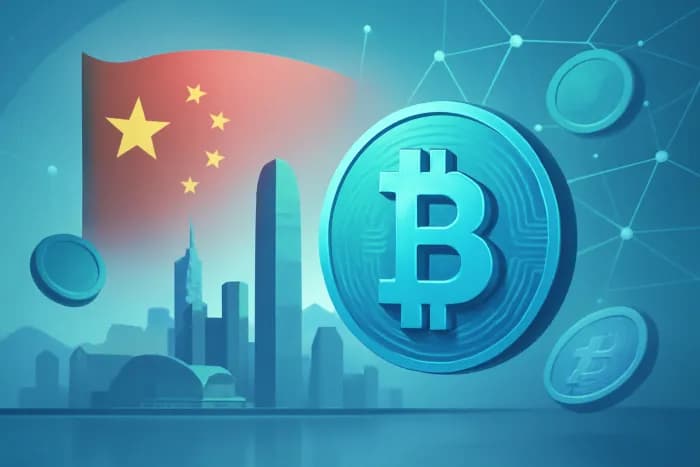
China’s RWA Chill in Hong Kong: Implications for Tokenized Assets
Beijing’s informal directive to pause RWA tokenisation in Hong Kong signals regulatory divergence in Greater China, chilling pipelines worth billions and reshaping tokenised asset strategies. This article analyzes affected deals, geopolitical context, and contingency paths for investors and builders.
Title: China’s RWA Chill in Hong Kong: Implications for Tokenized Assets
Introduction On September 23, Beijing’s securities watchdog quietly urged major brokerages to halt real-world asset (RWA) tokenization activities in Hong Kong. This informal directive chilled the city’s burgeoning tokenization ambitions despite Hong Kong’s new stablecoin licensing regime and LEAP legal review process. For U.S. investors and builders exploring RWA tokenization, this policy shift raises critical questions about capital at risk, geopolitical headwinds, and avenues for regulatory arbitrage. In this post, we unpack the policy divergence, quantify deal-level exposure, explore the U.S.–China tech rivalry, and outline strategies to manage risk and seize emerging opportunities.
- Regulatory Divergence: Beijing vs. Hong Kong
Beijing’s China Securities Regulatory Commission (CSRC) informally instructed Guotai Junan International, GF Securities, and others to pause RWA tokenization in Hong Kong, citing the need to “strengthen risk management” and ensure underlying assets derive from legitimate businesses (Reuters, Sept. 23, 2025). By contrast, Hong Kong has doubled down on digital-asset infrastructure:
• Project Ensemble’s sandbox (June 2025) is legally reviewing bond-market tokenization.
• The Stablecoins Ordinance (effective Aug. 1, 2025) mandates HKMA licensing and robust reserve, AML, and CTF controls for fiat-referenced coins (Reuters, May 21, 2025).
This divergence underscores Beijing’s priority onshore stability and Hong Kong’s effort to court global digital-asset firms with clear rules. Key takeaway: regulatory certitude in Hong Kong now contrasts sharply with Beijing’s post-2021 crypto caution.
- RWA Pipeline and Capital at Risk
With the regulatory contours defined, Hong Kong’s RWA tokenization pipeline spans fixed income, real estate, and carbon credits. The market currently stands at $29 billion and could top $2 trillion by 2030 (Reuters, Sept. 23, 2025). High-profile deals include:
• GF Tokens (GF Securities): Tracks U.S. Treasury, HKD, and offshore RMB yields on-chain; paused after CSRC guidance.
• CMBI Digital Bond: ¥500 million issuance for Shenzhen Futian Investment; now under review.
• Seazen Digital Assets Institute: Exploring real estate income and IP tokenization, targeting NFTs and tokenized funds by year-end.
• Ruifeng New Energy Carbon Credits: Tokenizing voluntary carbon credits to boost liquidity and transparency (Zhitong Finance, Jul. 15, 2025).
If these represent just 10% of the $29 billion pipeline, at least $2.9 billion is at risk. Key takeaway: the CSRC pause imperils a non-trivial slice of on-chain issuance.
- Geopolitical Underpinnings and Tech Rivalry Beyond direct deal risk, the halt reflects broader U.S.–China competition in digital finance and CBDCs. Under Project Ensemble, Hong Kong’s HKMA is trialing wholesale and retail CBDCs for tokenized deposits and asset settlement (HKMA, Jun. 23, 2025). Meanwhile, the PBoC’s digital yuan pilot remains cross-border only, lacking peer-to-peer functionality (Cointelegraph, May 17, 2024).
• Mainland regulators fear offshore digital channels may bypass onshore capital controls.
• Hong Kong welcomes licensed stablecoins (e.g., Standard Chartered’s, Animoca’s proposals) versus mainland’s tighter digital yuan scope.
• U.S. coins like USDC and USDT dominate global settlements, but unlicensed tokens remain barred in Hong Kong.
These dynamics fragment the settlement layer and raise policy-induced operational hurdles for tokenized projects. Key takeaway: geopolitical frictions amplify regulatory uncertainty.
- Navigating Regulatory Complexity: Hedging and Arbitrage To steer through mainland controls and Hong Kong’s licensed regime, RWA issuers and investors can pursue two complementary approaches:
A. Risk-Mitigation Strategies
• Jurisdictional Diversification: Shift issuance to Singapore, Switzerland, U.S. states, or UAE (VARA, FSRA); leverage the EU’s MiCA pilot and Switzerland’s DLT Act for security tokens (Antier, 2025).
• Modular Token Structures: Implement cross-chain wrappers (e.g., Ondo Finance’s USDY model) to mint exposures via non-mainland entities and enforce lock-ups (AiCoin, Aug. 2025).
• Compliant Settlement Rails: Anchor on HKMA-licensed stablecoins or wCBDC; use platforms like Plume that integrate institutional coins (Agora’s AUSD) for transparent, fully backed settlements (Plumeberg, Aug. 2025).
B. Arbitrage Tactics
• Monitor HKMA license register and CSRC notices for shifting guidelines.
• Engage legal counsel to structure entities outside mainland brokerages.
• Stress-test pipelines against counterparty concentration and sudden rule changes.
• Explore secondary distributions via EU or U.S. venues to avoid single-market exposure.
Key takeaway: blending jurisdictional agility with on-chain innovation turns policy hurdles into competitive edges.
Conclusion Beijing’s informal freeze on mainland brokerages’ Hong Kong RWA tokenization illuminates the perils and possibilities in Greater China’s fractured digital-asset landscape. U.S. investors and builders must deploy robust risk analytics, map policy exposures, and adopt flexible structures to protect capital—and capitalize on Hong Kong’s HKMA-approved frameworks and wCBDC pilots. As the RWA market expands from $29 billion toward $2 trillion by 2030, success will hinge on marrying regulatory agility with on-chain innovation to transform policy obstacles into strategic advantages.