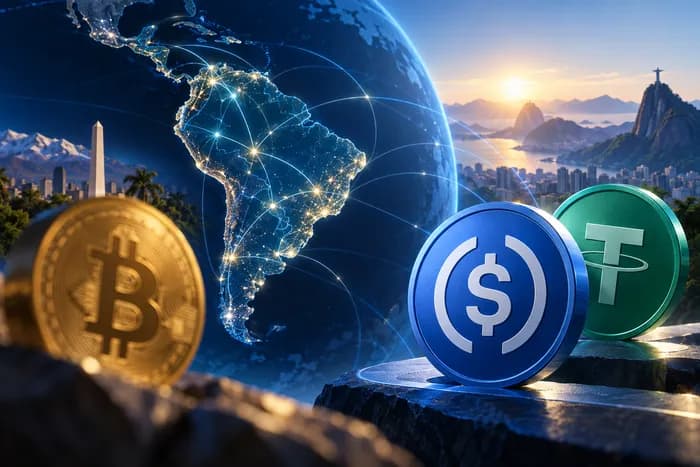
Beyond Bitcoin: How LatAm Demand Fuels the Stablecoin Arms Race
Latin America’s accelerating digital dollarization is turning stablecoins into critical financial infrastructure. Binance’s $100 million Circle investment shows why USDC expansion—and the contest with USDT—may matter more structurally than Bitcoin’s latest rally.
Bitcoin’s move above $86,000 has renewed the market’s appetite for headline-grabbing price action. The asset closed at $86,603 on September 21, gaining 6.73% in a single day and recording its highest close since late January 2026, according to The Rio Times on September 22, 2026.
Yet crypto’s more durable story may be unfolding away from speculative trading. Across Latin America, households and businesses are increasingly using stablecoins as accessible digital dollars—for savings, payments, payroll, and cross-border transfers. That demand helps explain why distribution has become central to stablecoin strategy, including Binance’s $100 million investment in Circle and the companies’ five-year agreement to expand USDC globally.
For investors, the implication is clear: Bitcoin remains crypto’s flagship asset, but stablecoins are competing to become its financial operating system. Latin America offers an early view of how that competition could develop across emerging markets worldwide.
Latin America’s Real Crypto Story Is Digital Dollars
Bitcoin’s rally reflects renewed risk appetite, but activity in Latin America reveals a different kind of demand. Brazilian investors purchased approximately $6.9 billion in crypto assets from abroad during the first quarter of 2026, with stablecoins representing roughly 98% of the total, according to The Rio Times’ September 22 report. The pattern points less to speculation than to demand for dollar exposure delivered through blockchain rails.
Argentina provides another striking example. On Bitso, 57% of the country’s 2025 crypto purchases were in USDT, while another 14% were in USDC. Combined, stablecoins accounted for 71% of purchases. These tokens can help users reduce exposure to local-currency depreciation without securing physical dollars or opening an offshore bank account.
El Salvador presents a more measured case. Crypto-wallet remittances reached $41.11 million between January and July 2026, up 35.7% year over year, but still represented only 0.69% of total remittances, according to the same September 22 analysis. The infrastructure is growing, but conventional channels remain dominant. Investors should distinguish between rapid percentage growth and meaningful market penetration.
Why Stablecoins Beat Volatility for Everyday Users
Bitcoin may support a long-term store-of-value thesis, but its volatility limits its usefulness for rent, payroll, and short-term savings. Stablecoins preserve crypto’s portability and round-the-clock settlement while targeting a predictable dollar value.
For households facing inflation or currency depreciation, converting savings into a dollar-backed token can be economically rational. OMFIF wrote on September 23, 2026 that stablecoins reduce traditional barriers to dollarization, including dependence on banknotes, foreign accounts, and financial intermediaries. This is bottom-up digital dollarization.
Where users already rely on exchanges and digital wallets to access dollar exposure, distribution can strongly influence which stablecoin they hold. That makes partnerships between issuers and major exchanges strategically important.
Binance and Circle Turn Distribution Into Strategy
Circle’s challenge is not simply issuing a regulated dollar token. It must place USDC where users already trade, save, and transfer value. Binance offers a powerful global distribution channel, with particular relevance in emerging markets where exchange access can be an important gateway to digital dollars.
Under Binance’s investment in Circle, the exchange purchased 1,237,011 Circle Class A common shares through a private placement that closed on September 17. The transaction was valued at $100 million, and Binance retains voting rights while being prohibited from selling, pledging, or hedging the shares during the applicable lockup, according to Yahoo Finance on September 22, 2026.
The equity stake accompanies an expanded five-year commercial agreement. Circle will pay Binance a monthly incentive linked to USDC balances held through Circle’s wallet infrastructure, while Binance will promote and integrate USDC across its ecosystem.
The important point is economic alignment. Rather than rewarding only temporary trading activity, the arrangement gives Binance an incentive to support sustained USDC holdings and usage. Binance co-CEO Richard Teng described the transaction as evidence of the company’s “long-duration conviction” in Circle’s technology in CNBC’s September 22 coverage.
Why the Incentive Structure Matters
Trading pairs can create short-lived volume, but balance-based incentives encourage an exchange to support deeper, more persistent use of a stablecoin. That could include merchant settlement, exchange collateral, savings products, cross-border transfers, and embedded wallets.
If successful, Circle gains more than transaction volume. It gains a recurring role in one of crypto’s largest distribution networks. Still, the agreement is global in scope: Latin America is best viewed as a compelling example of the demand opportunity, not as proof that the partnership will succeed in every market.
USDC Is Challenging USDT’s Emerging-Market Moat
Tether enters this contest with substantial advantages. USDT already has deep liquidity, broad wallet support, and strong brand recognition among users seeking digital-dollar exposure. Argentina’s Bitso mix—57% USDT versus 14% USDC—illustrates the scale of that incumbent lead in a major Latin American market.
Circle’s strategy is to counter that advantage through regulated infrastructure, institutional relationships, and aggressive distribution. The Binance agreement adds a channel capable of placing USDC before millions of users who might otherwise default to USDT.
This does not guarantee that USDC will displace Tether. Stablecoin markets have strong network effects: traders prefer the asset accepted by counterparties, exchanges favor assets with liquidity, and merchants support what customers already hold. Circle must therefore compete on availability, local fiat conversion, wallet integration, liquidity, and real-world utility—not solely on reserve quality or regulatory positioning.
The wider prize extends beyond token market capitalization. A successful stablecoin can generate reserve income, settlement activity, exchange liquidity, and integration demand across wallets, payment processors, and tokenized-asset platforms. The issuer whose token becomes the preferred digital dollar in emerging markets could occupy a strategically important position in global finance.

Adoption Creates Risks Alongside Opportunity
Digital dollarization solves real user problems, but it can also move savings and payments outside domestic monetary systems. OMFIF’s September 23 analysis notes that around 98% of stablecoin value is denominated in U.S. dollars and warns that large-scale adoption can weaken monetary sovereignty by shifting saving, pricing, and transactions toward privately issued dollar instruments.
That tension could produce tighter rules governing stablecoin distribution, promotion, reporting, licensing, or use in affected countries. Investors should not assume that strong user demand will automatically translate into frictionless growth.
Stablecoins also carry issuer, reserve, redemption, chain, bridge, and counterparty risks. A token designed to maintain a value of one U.S. dollar is not equivalent to a bank deposit or a central-bank liability. Investors evaluating USDC, USDT, or related ecosystem tokens should examine reserve transparency, redemption access, jurisdictional exposure, liquidity concentration, and dependence on major exchanges.
What Crypto Investors Should Monitor
The stablecoin race should be measured through operating health rather than announcements alone. Investors can focus on several indicators:
- Regional supply growth: Is USDC circulating supply expanding on chains and platforms commonly used in Latin America?
- Persistent balances: Are users retaining USDC, or merely passing through it to reach other assets?
- Liquidity quality: Are spreads, market depth, and fiat conversion routes improving relative to USDT?
- Transfer behavior: Is growth driven by genuine payment and savings activity, or by exchange-led incentives?
- Concentration risk: How much adoption depends on Binance, a small number of market makers, or one blockchain?
- Peg and redemption health: Do secondary-market prices, reserve disclosures, and redemption conditions remain stable during volatility?
The $100 million investment should be treated as the beginning of an execution period, not proof of victory. The strongest confirmation would be sustained USDC balance growth, deeper local liquidity, and increased real-economy usage without deteriorating peg stability, counterparty quality, or regulatory access.
Conclusion
Latin America demonstrates why the next phase of crypto adoption may look less like speculative token buying and more like a competition to distribute digital dollars. Brazil’s stablecoin-heavy crypto purchases from abroad and Argentina’s preference for USDT and USDC show that many users are prioritizing currency stability and financial access.
Binance’s investment gives Circle a powerful route to challenge USDT’s established position, while its balance-linked incentive structure makes the partnership unusually focused on sustained adoption. But USDT’s network effects remain formidable, and growth will depend on local liquidity, utility, regulation, and issuer resilience—not on partnership announcements alone.
Bitcoin’s $86,603 close is an important market signal. The deeper structural signal is the battle over which stablecoin becomes the default savings, payment, and settlement asset for millions of users. Monitoring adoption quality, liquidity, issuer health, and distribution concentration will be essential as that race accelerates.