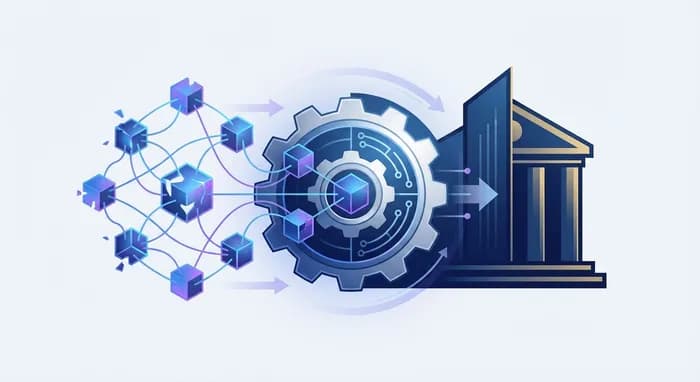
The Governance Pivot: Why DAOs Must Trade Ideals for Capital
DAOs are entering a new phase where ideological decentralization is colliding with market reality, regulatory clarification, and institutional demands. Recent SEC guidance and the Tally shutdown suggest that the next generation of on-chain organizations will likely be more compliant, more centralized, and more investable.
For years, the fully decentralized DAO model was sold as a superior organizational form: internet-native, credibly neutral, and free from the compromises of traditional corporate structure. That vision produced meaningful experimentation, but in 2026 the market is signaling that ideals alone are no longer enough. If governance cannot generate revenue, attract durable users, or meet legal and fiduciary expectations, it struggles to survive.
Two recent developments sharpen that reality. First, the SEC and CFTC jointly clarified, in a March 17 interpretation, how federal securities laws and the Commodity Exchange Act apply to crypto assets, with SEC Chair Paul Atkins stating that most crypto assets are not securities in themselves while emphasizing a framework meant to bridge the market until Congress finalizes broader structure legislation (SEC, 2026-03-17). Second, DAO governance platform Tally is winding down after serving more than 1 million users, supporting governance for hundreds of organizations, and processing approximately $1 billion in payments, citing a lack of a viable market for DAO tooling (Cointelegraph via DeFi tag page, recent coverage).
Taken together, these developments point to a broader governance pivot. Regulation is becoming more legible at the same time that the market is rewarding only those governance systems that can support institutional capital, durable operations, and clear accountability. For crypto investors, the key question is no longer whether DAO governance matters; it is which governance models can capture institutional DeFi flows, comply with SEC crypto regulation, and support blockchain corporate partnerships without eroding tokenholder value.
Why the pure DAO model is running into commercial reality
The idealistic case for crypto decentralization assumed that open participation would naturally produce resilient organizations. In practice, many DAOs discovered that coordination is expensive, voter turnout is low, decision cycles are slow, and accountability is diffuse. Those problems are manageable in volunteer communities; they become existential when a protocol needs enterprise sales, compliance staffing, treasury discipline, and product execution.
That is why Tally's shutdown matters far beyond one company. According to recent reporting, Tally is winding down despite serving over 1 million users, supporting governance across hundreds of organizations, and processing $1 billion in payments, because it no longer sees a viable market for DAO tooling (Cointelegraph via DeFi tag page). For investors, that is a hard market signal: usage at the governance layer did not translate into a sufficiently durable business model.
The implication is uncomfortable but important. DAO governance has generated political activity on-chain, yet that activity often has weak monetization. Tokenholder voting can look impressive in dashboards while failing to generate cash flow, enterprise demand, or sustainable margins. When a foundational tooling provider exits anyway, investors should ask whether a protocol's governance footprint is actually producing strategic value or merely governance theater.
Governance activity is not the same as business viability
Many governance tokens still trade on narratives of community ownership, but community ownership alone does not create demand from institutions. Capital allocators want clear operating authority, reliable disclosures, legal recourse, and predictable decision-making. If a DAO cannot offer those, its token may represent participation without power or exposure without protection.
That distinction is especially important in a higher-scrutiny environment. A token can retain social relevance while its surrounding governance system loses commercial relevance. TokenVitals-style risk analysis should therefore separate governance participation metrics from measures like treasury runway, legal structuring, counterparty readiness, and execution concentration.
SEC and CFTC guidance changes the strategic calculus
The March 17 SEC interpretation is the most important near-term regulatory catalyst in this discussion. The agency said it is clarifying how federal securities laws apply to crypto assets, and the CFTC joined the interpretation so the Commodity Exchange Act can be applied consistently across the market (SEC, 2026-03-17). Chair Paul Atkins also said that most crypto assets are not themselves securities, while framing the effort as a bridge as Congress continues work on market structure legislation (SEC, 2026-03-17).
For DAOs, the message is not simply "regulation is easing." The real message is that classification, disclosures, issuance mechanics, and organizational behavior now matter more—not less. Clarification helps serious operators, but it also raises the bar for anyone hoping to attract outside capital. Institutional investors do not just want fewer legal gray areas; they want governance systems designed to function inside whatever legal perimeter emerges.
Where things stand now is that Congress is still working on broader market structure legislation, according to the SEC's own framing, so this area remains transitional rather than fully settled (SEC, 2026-03-17). That makes interim governance design critical. Protocols that can map token rights, treasury controls, and delegation processes onto recognizable compliance structures are better positioned than protocols still relying on purely ideological decentralization.
Regulatory clarity favors legible organizations
The biggest winners from SEC crypto regulation may not be the most decentralized teams, but the most legible ones. Legibility means clear responsibility centers, documented governance processes, known signers or delegates, treasury controls, and the ability to interface with service providers, auditors, and regulated capital pools.
In other words, clarification rewards DAOs that behave more like institutions even if they still govern on-chain. That does not eliminate the value of decentralization; it changes where decentralization is most useful. Markets may continue to value transparent voting and community oversight, but operating control may increasingly migrate toward foundations, core companies, councils, or legally wrapped entities.
Institutional DeFi demands oversight, not ideology
Recent reporting also highlights a broader strategic shift: DAOs may need to reduce decentralization to win institutional business, because institutional adoption is pushing organizations to choose between crypto ideals and commercial partnerships (Cointelegraph via DeFi tag page). That framing may sound harsh, but it aligns with how TradFi integration actually works.
Large allocators and enterprise partners generally cannot deploy capital into systems where treasury decisions are unpredictable, signers are anonymous, liability is unclear, and governance proposals can materially alter risk without professional oversight. They need counterparties that can sign agreements, maintain controls, and respond to legal or operational incidents. In practice, that means institutional DeFi usually prefers semi-centralized governance layers over fully decentralized ones.
This is not necessarily a betrayal of crypto's core innovation. It may instead be a segmentation of functions. Settlement, transparency, and verifiability can remain on-chain, while governance becomes more managed, professionalized, and legally wrapped. The result is a model closer to open infrastructure with supervised administration than the original DAO ideal.
For investors, that shift changes how governance tokens should be analyzed. A token tied to a protocol pursuing blockchain corporate partnerships may benefit from clearer execution and better access to capital, but it may also lose some of the optionality associated with open-ended community control. The upside comes from institutional compatibility; the risk is governance centralization and the possibility that tokenholders become economically subordinate to off-chain entities.

What institutions are actually buying
Institutions are not buying decentralization as a moral good. They are buying exposure to yield, infrastructure, settlement efficiency, tokenized assets, and programmable financial rails. Governance is only valuable to them if it reduces risk and improves accountability.
That means the market increasingly rewards DAOs that can translate on-chain participation into off-chain trust. The protocols best positioned for TradFi integration are likely those with formal committees, transparent treasury mandates, legal wrappers, and narrowly scoped tokenholder powers rather than unrestricted plebiscites.
What the corporate pivot means for governance tokens
If the governance pivot continues, governance tokens will need to justify their role differently. The old thesis was simple: tokenholders control the protocol, therefore the token is valuable. The new thesis is more demanding: tokenholders must retain economically meaningful rights inside a structure that institutions can use.
That creates both opportunity and risk. On the opportunity side, semi-centralized, legally compliant DAOs may attract deeper liquidity, stronger partners, and more sustainable revenue because they can execute faster and meet diligence standards. On the risk side, governance tokens may be diluted in practical importance if boards, foundations, operating companies, or special committees make most consequential decisions.
Investors should therefore focus on five indicators. First, who really controls the treasury? Second, what rights does the token have relative to legal entities around the protocol? Third, how concentrated is voting power among delegates, insiders, or service providers? Fourth, can the organization enter and maintain enterprise-grade partnerships? Fifth, does the governance process improve business performance, or merely ratify decisions already made elsewhere?
Those questions matter more after the Tally shutdown because they cut through a common illusion: visible governance infrastructure does not guarantee durable value creation (Cointelegraph via DeFi tag page). They also matter more after the SEC's clarification because protocols now have stronger incentive to make their governance structures intelligible to regulators and institutions alike (SEC, 2026-03-17).
A practical framework for investors
A healthier governance token in this environment is not necessarily the one with the most radical decentralization. It is the one attached to an organization that can balance three things: credible on-chain transparency, a legally coherent operating structure, and real commercial momentum.
That is where TokenVitals-style analysis becomes useful. Investors should score governance systems not just on decentralization optics, but on execution quality, regulatory preparedness, treasury resilience, and partnership readiness. In the next cycle, those factors may matter more than ideological purity.
Conclusion
The past week has made that clearer. The SEC and CFTC have signaled a more structured path for crypto markets, while Tally's wind-down has exposed the weak commercial foundations of parts of the DAO tooling stack (SEC, 2026-03-17; Cointelegraph via DeFi tag page). At the same time, institutional pressure is pushing DAOs toward governance models that favor oversight, legal clarity, and business execution over maximal crypto decentralization (Cointelegraph via DeFi tag page).
For U.S. crypto investors, the takeaway is straightforward: the next winners in DAO governance will probably look less like digital communes and more like compliant, semi-centralized capital allocators built on open rails. That may disappoint purists, but it could unlock the institutional liquidity that the sector has chased for years. The key is to distinguish between decentralization as branding and governance as investable infrastructure.