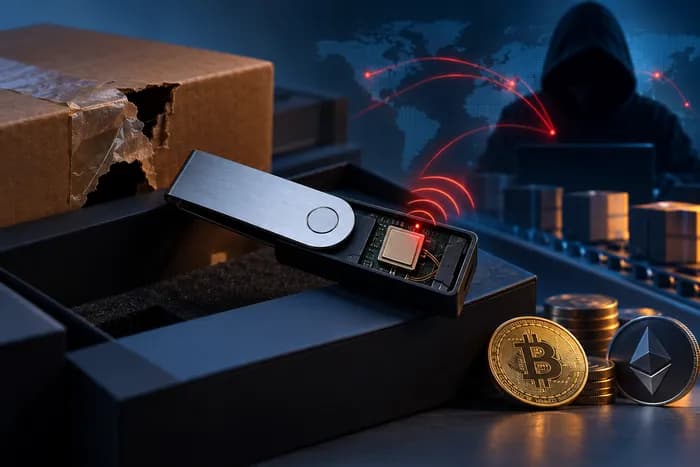
Supply Chain Hacks: The End of Cheap Crypto Cold Storage
Hardware wallet supply chain attacks have shattered the assumption that offline storage is automatically secure. Here is how physical implants threaten seed phrase security, whether the $849 Ledger Atom is justified, and how investors can build stronger crypto custody systems.
For years, crypto investors followed a simple security rule: move meaningful holdings off exchanges and into hardware wallets. That advice remains sound. But a newly disclosed supply-chain attack in Southeast Asia shows why “offline” should never be confused with “impenetrable.”
Modified Ledger devices reportedly captured users’ recovery phrases during setup and transmitted them to attackers over cellular networks. Millions of dollars in losses were reportedly linked to devices distributed through an authorized intermediary, according to an October 14, 2026, Cointelegraph investigation. The reported incident shifts the threat model beyond phishing and computer malware to something much harder for ordinary investors to detect: hardware that may already be compromised when it arrives.
The lesson is not that crypto cold storage has failed. It is that low-cost, single-device custody should no longer be treated as a complete strategy for portfolios large enough to justify targeted attacks.
How the Hardware Implant Attack Worked
A conventional hardware wallet is designed to isolate private keys from an internet-connected computer or phone. The reported Southeast Asian attack did not need to break that protected signing environment. Instead, hidden components allegedly captured recovery-phrase words as they appeared during device initialization and then transmitted the stolen phrases through cellular connectivity.
That distinction is critical. An attacker does not necessarily need to defeat the wallet’s secure chip or alter the transaction-signing process. A recovery phrase is the master backup for the wallet: anyone who obtains it can reconstruct the wallet and control its assets elsewhere.
Firmware verification can confirm whether approved software is running, but a separate implant that monitors screen output or display signals may not need to modify the firmware, private-key chip, or signing process. The device can therefore appear to work normally while leaking the one secret that matters most.
Ledger said genuine devices had been opened, fitted with custom components, and returned to the reseller distribution chain. In its October 15 response, the company characterized the event as a localized distribution attack rather than a compromise of its operating system, servers, or secure chips. Ledger also said it was working with law enforcement and would release additional technical information when possible.
Why Users Could Not Easily Detect It
Packaging seals, firmware checks, and visual inspections remain useful, but none can guarantee that sophisticated physical tampering will be found. Hardware security researcher Joe Grand told Cointelegraph that even highly technical users do not routinely disassemble and inspect every device they receive. Other experts recommended spreading trust across multiple providers rather than depending on one manufacturer or distribution chain, according to the same October 14 report.
In other words, authenticity checks can reduce risk, but they cannot eliminate the possibility of a carefully targeted supply-chain compromise.
Where the Investigation Stands Now
As of October 16, 2026, the matter has not been declared resolved. Ledger said it had conducted its largest investigation to date, examined retail and warehouse samples, and found no evidence of tampering in the units it tested. However, it asked authorized resellers and distributors in Southeast Asia and Hong Kong to suspend sales while the investigation continued.
The company has also tightened handling rules for its authorized network. Returned devices must never be resold, products should no longer be placed on open shelves or displays, and inventory should remain in controlled storage until purchase. Those changes acknowledge that crypto-custody security includes provenance, warehousing, returns processing, and last-mile retail handling—not merely cryptography.
Investors should not interpret “authorized reseller” as equivalent to “zero risk.” Authorization reduces uncertainty, but the reported Ledger supply-chain incident shows that intermediaries can still become points of compromise.
Ledger Atom: A Potential Response, Not a Complete Answer
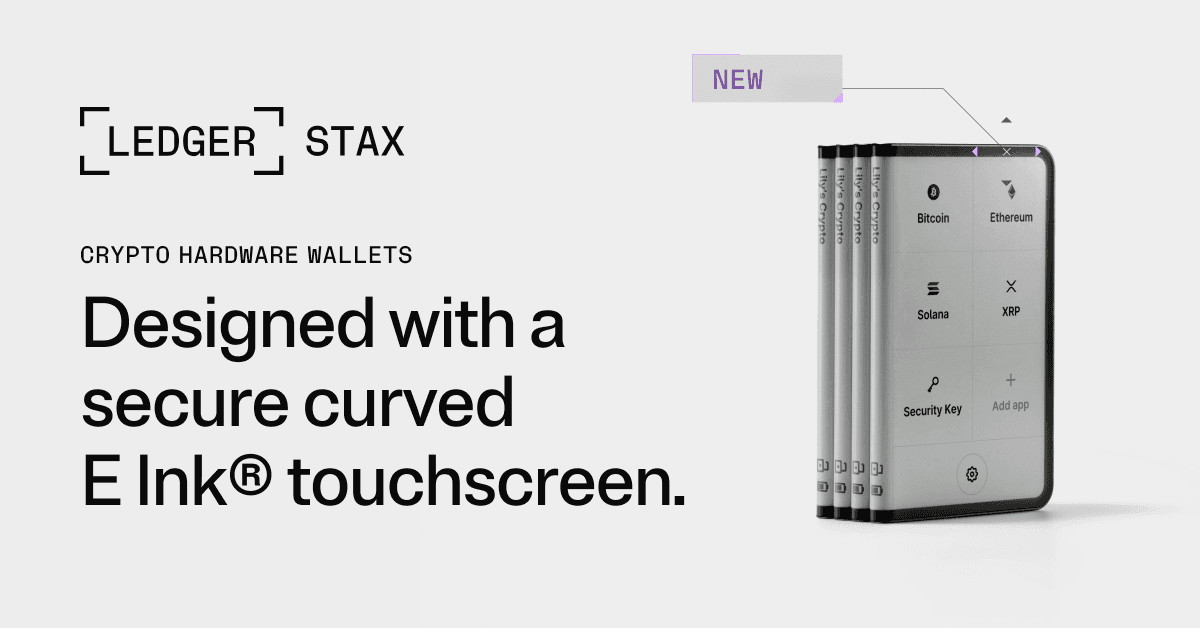
Ledger unveiled the Ledger Atom on October 15 at a reservation price of $849, according to Cointelegraph’s October 15 crypto roundup. The product is still in development, with Ledger estimating delivery in the second quarter of 2027 and warning that specifications, timing, and pricing may change.
Atom is Ledger’s proposed architectural response to the kind of physical tampering described above. Its Secure Mode uses physically separated chips for sensitive operations, while an FPGA acts as a hardware switch controlling access to the display and touchscreen. Active anti-tampering protection surrounds the Secure Element, graphics microcontroller, and FPGA. Opening the enclosure is designed to trigger a tamper event that requires a Ledger-supervised reset, according to the company’s October 15 technical whitepaper.
That could be a meaningful improvement, but it does not make Atom an automatic purchase. At nearly $1,000, it may be reasonable for investors protecting substantial portfolios, business assets, or high-value credentials. For a modest portfolio, a properly designed multisignature setup using less expensive devices may provide better risk reduction per dollar.
Protection Is Not the Same as Proof
Atom’s features are manufacturer claims for a product that has not yet shipped. Ledger says the complete system will undergo product-level evaluation and independent audits, with results expected after launch. Investors should therefore distinguish between a promising security architecture and protections independently demonstrated in production hardware.
A Better Model: Eliminate Single Points of Failure
The strongest response is not necessarily a more expensive wallet. It is a custody design in which one compromised device, vendor, shipment, or exposed recovery phrase cannot move the portfolio.
A 2-of-3 multisig wallet requires two independently controlled keys to authorize a transaction. Investors can generate those keys on devices from different manufacturers, buy them through separate direct channels, and store them in different physical locations. An attacker who compromises one vendor, shipment, or recovery phrase still lacks the second required signature.
Diversification must be genuine. Buying three identical wallets in a single order creates correlated risk. Better separation means using different manufacturers, order dates, delivery addresses where practical, setup environments, and backup locations. Never import the same recovery phrase into multiple devices and call the arrangement multisig; that merely duplicates one point of failure.
Multisig custody adds operational complexity. Investors must preserve wallet configuration data, understand recovery procedures, and test small transactions before depositing significant funds. The objective is not maximum complexity. It is ensuring that no single component can cause a catastrophic loss.
A Practical Custody Checklist
Start by sizing the security system to the value and concentration of the portfolio. A basic hardware wallet purchased directly from its manufacturer may remain appropriate for lower-value holdings, provided the device generates a new recovery phrase during setup and passes the manufacturer’s authenticity checks.
For larger positions, treat crypto custody as a layered risk-management process:
- Purchase only through the manufacturer’s verified website or a distribution channel confirmed on that website.
- Reject devices that arrive initialized, contain prewritten recovery phrases, or show unexpected packaging damage.
- Generate each recovery phrase on the device, and never photograph, scan, type, or upload it.
- Confirm receiving addresses and transaction details on the trusted hardware display.
- Use a passphrase or multisig only after documenting and testing the recovery process.
- Separate keys and backups geographically while protecting them against theft, fire, and unauthorized access.
- Replace any signer with questionable provenance and migrate assets to newly generated keys. If a recovery phrase may have been exposed, replacing the device alone is not enough.
- Monitor wallet activity so that an unexpected transfer or approval triggers a preplanned response.
At TokenVitals, custody belongs inside portfolio health analysis. Smart-contract audits, liquidity conditions, and token concentration matter, but an asset is not secure if its custody model depends on one unverified device and one recovery phrase.
Conclusion
Standard hardware wallets are not obsolete, but blind trust in cheap, single-device crypto cold storage should be. The latest physical-tampering incident shows that recovery-phrase security begins before a wallet reaches the buyer and extends through setup, backup, and transaction approval.
Ledger Atom may become an attractive premium option if independent reviewers validate its anti-tampering architecture. Investors do not need to wait, however. Verified purchasing channels, fresh on-device recovery-phrase generation, separated backups, and multi-vendor multisig can reduce supply-chain risk today—without assuming that any box, seal, or brand is infallible.
Because both the investigation and Atom’s development are ongoing, investors should independently verify new information before making custody decisions.