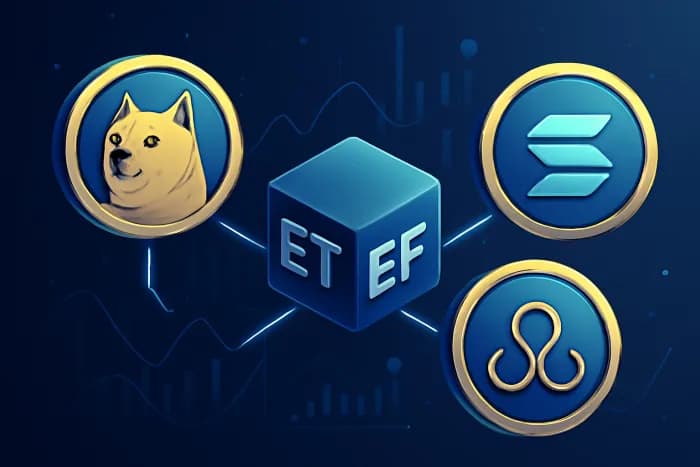
Meme-Coin ETFs on Deck: DOGE, SOL, XRP—Path, Risks and Market Impact
As the SEC advances generic listing standards for crypto ETPs, meme-coin ETFs for DOGE, SOL, and XRP could join spot BTC and ETH funds soon. This post unpacks the regulatory pathway, outlines specific risks, models potential market effects, and delivers actionable strategies for traders.
Title: Meme-Coin ETFs on Deck: DOGE, SOL, XRP—Path, Risks and Market Impact
Introduction: Is the Meme-Coin ETF Era Upon Us? The SEC stands poised to finalize generic listing standards that could slash approval timelines for crypto exchange-traded products from 240 days to roughly 75. That shift would open the door to spot ETFs built on meme-coins like Dogecoin (DOGE), Solana (SOL) and Ripple (XRP), raising key questions: How will these funds differ from the pioneering Bitcoin and Ether ETFs, and what market ripples lie ahead? With filings already in motion—and retail anticipation running high—understanding the path, risks and potential impact is critical.
The Regulatory Pathway: From Form 19b-4 to Form S-1 Effectiveness Today, exchanges push a Form 19b-4 rule-change petition and issuers file a separate Form S-1, each requiring lengthy SEC review. Under the proposed generic rule, qualifying crypto ETFs would bypass dual filings: they’d submit an S-1, observe a 75-day window, then list if they meet criteria such as six months of regulated futures trading, strict liquidity controls and surveillance-sharing agreements. This streamlined route could trigger a wave of new products aimed squarely at meme-coin enthusiasts.
Key Filings on the Horizon: DOGE, SOL, XRP
• Grayscale’s spot Dogecoin Trust and XRP Trust filings (Feb. 2025) are under 240-day review through mid-October 2025.
• Nasdaq’s April 30 Form 19b-4 for the 21Shares Dogecoin ETF on NYSE Arca follows Franklin Templeton’s XRP extension.
• REX Financial’s REX-Osprey Sol + Staking ETF—an alternative structure—raised $12 million at launch, signaling demand even before generic listing approval.
• (Sidebar) Canary Capital’s ‘Official Trump Meme Coin’ ETF application underlines the SEC’s openness to politically infused tokens—but also underscores fragmented standards for novel assets.
Structural Differences and Risk Profile How Meme-Coin ETFs Differ from BTC and ETH Spot ETFs The first Bitcoin and Ether ETFs combined Form S-1 effectiveness with exhaustive Form 19b-4 surveillance-sharing, cash-only creations/redemptions and bespoke risk negotiations. Under the new generic standard, meme-coin funds could allow in-kind creations/redemptions, standardized disclosures and faster rollouts—cutting transaction costs and negotiation delays.
Specific Risks for Meme-Coin ETPs
• Liquidity: SOL and XRP futures launched in March and May 2025 respectively; DOGE futures volumes lag behind, risking thin order books.
• Custody: July 7 SEC guidance mandates transparent, multi-custodian cold-storage setups to secure volatile tokens.
• Manipulation: Exchanges must prove fraud-prevention capabilities via surveillance-sharing with high-liquidity venues—a tougher hurdle for coins spread across fragmented markets.
Market Impact: Benchmarking Potential Inflows Bitcoin’s 2024 ETF debut drew about $65 billion in the first year; Cathie Wood’s ARK Innovation ETF saw a $767 million one-day spike in August 2025. If meme-coin ETFs capture just 10% of Bitcoin’s momentum, expect $6–7 billion in initial inflows—enough to stress test token prices and liquidity. Such capital could eclipse thematic equity funds, signaling a seismic shift in crypto allocation.
Technical Modeling: Implied Volatility and Correlation Shifts Options traders price ETF events well in advance. Ether’s implied volatility traded ~15% above Bitcoin’s ahead of its ETF approval, while DOGE’s realized vol jumped to 17.6% amid mid-July institutional positioning—implying a 10–20% IV premium on ETF speculation. Historically, Bitcoin ETF flows correlate at r = 0.73 with price changes; Ether, r = 0.79—highlighting robust price signaling post-launch.
Retail Trading Dynamics: The TikTok-Driven Sentiment Cycle TikTok’s algorithm can package meme-coin hype into 200-video clusters that amplify FOMO. SOL and DOGE rallies have been propelled by viral clips; in May 2025, Gov.Capital recorded $4.6 billion in daily meme-coin volume. These rapid spikes often retrace just as fast, making retail sentiment both an accelerator and a risk vector.
Actionable Considerations for Traders
Building on the risks and market signals above, consider the following strategies:
• Arbitrage Opportunities: Exploit 15–75-minute ETF-spot price gaps, especially across Asian and U.S. venues, given higher NAV premiums in crypto ETPs.
• Derivatives Pricing: Watch put/call skew and term-structure anomalies. An IV premium >40% vs. realized often flags mispricing ahead of filings.
• Tax Nuances: Navigate IRS rules (§ 1(h) for short-term capital gains) to optimize arbitrage gains and minimize unexpected liabilities.
Conclusion: Preparing for the Meme-Coin ETF Wave The SEC’s generic listing standards are likely to transform meme-coins from fringe curiosities into mainstream investable assets. Key takeaways:
- Regulatory Shift: 75-day S-1 window vs. 240-day 19b-4 petitions.
- Liquidity & Custody: Guard against thin markets and custody gaps.
- Retail Dynamics: Expect FOMO-driven volume spikes and sharp retracements.
- Strategy: Leverage arbitrage, monitor IV skews, optimize tax outcomes.
For robust analysis and real-time risk modeling, platforms like TokenVitals can help quantify ETF health metrics and execution risks—arming you to navigate this emerging frontier with confidence.