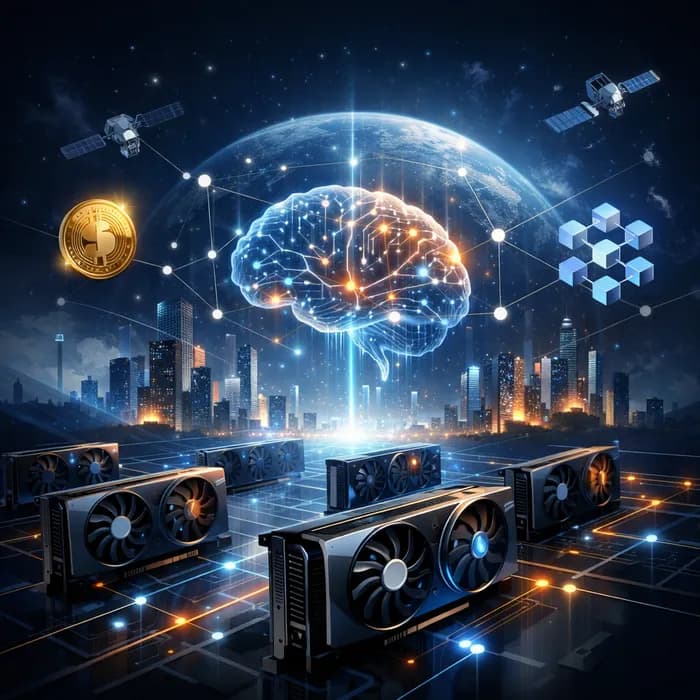
DePIN’s GPU Wars: Can Decentralized Compute Solve the Global AI Chip Shortage?
As the AI boom depletes global GPU supplies, DePIN protocols like Render and Akash Network are aggregating idle hardware to challenge Big Tech. We analyze the investment case for decentralized compute and the technical realities of Web3 AI infrastructure.

The artificial intelligence gold rush has triggered a hardware crisis. As OpenAI, Google, and thousands of startups race to build more powerful Large Language Models (LLMs), they have hit a concrete wall: a severe global shortage of high-performance Graphics Processing Units (GPUs). With Nvidia’s enterprise-grade chips backlogged for months and cloud computing costs from AWS and Azure skyrocketing, the market is desperate for an alternative. Enter Decentralized Physical Infrastructure Networks (DePIN)—blockchain-based protocols that aggregate idle global computing power to offer a permissionless, cost-effective lifeline to the AI industry.
The Bottleneck: AI’s Insatiable Hunger for Hardware
The narrative of the current market cycle is defined by the intersection of AI and crypto, but the underlying mechanics are driven by supply and demand. Training foundation models requires massive computational throughput. Nvidia’s H100 GPUs have become the world's most sought-after commodity, with lead times stretching nearly a year. For centralized cloud providers, this scarcity allows for premium rates, squeezing the margins of smaller developers and creating single points of failure. DePIN proposes a radical shift from centralized server farms to a distributed global supercomputer.
Enter DePIN: The 'Airbnb' of High-Performance Computing
DePIN protocols operate on a simple premise: there is a vast amount of latent computing power sitting idle in gaming PCs, crypto mining rigs, and Tier 2 data centers. By tokenizing this infrastructure, these protocols aggregate fragmented resources into a unified decentralized cloud. This model offers two distinct advantages: 1. Cost Efficiency: Decentralized compute is often 60-80% cheaper because it utilizes sunk-cost hardware. 2. Permissionless Access: Developers can access resources without corporate contracts or de-platforming risks. To see this theory in practice, we must examine the operational mechanics of the current market leaders.
Frontline Protocol Analysis:
Render Network vs. Akash Network
Render Network (RENDER)
Originally for 3D rendering, Render has pivoted to Web3 AI, migrating to Solana for higher throughput. Its strategic value lies in its network of consumer-grade GPUs (RTX 4090s). While not ideal for massive foundation training, they are exceptionally capable for AI inference and fine-tuning. As the market matures, the demand for inference will likely outstrip training, positioning Render favorably.
Akash Network (AKT)
A Cosmos-based Supercloud, Akash uses a reverse-auction mechanism where users set a price and providers bid. Akash targets the high-performance sector by onboarding providers with enterprise-grade chips like A100s. Monitoring Akash’s active lease stats provides a real-time health metric of network adoption versus speculative hype.

The 'Compute-as-a-Currency' Thesis
The economic engine is the 'Compute-as-a-Currency' thesis, where power is commoditized and priced dynamically. For providers, it turns hardware liabilities into income-generating assets. For investors, compute tokenization creates a direct value accrual mechanism, linking the token price to the real-world growth of the AI sector.
Critical Challenges: Latency, Verification, and Privacy
Despite the bullish outlook, hurdles remain. The 'Latency Problem' makes DePIN best suited for parallelizable workloads or inference rather than large-scale training. Furthermore, networks need 'Proof of Compute' to verify work, and enterprise clients require solutions for 'Data Privacy' like Trusted Execution Environments (TEEs).
Strategic Outlook for Investors
The convergence of AI and Crypto is an infrastructural necessity. Investors should focus on protocols with high supply-side quality (H100/A100), proven utilization metrics, and strong ecosystem integration, particularly within the Solana DePIN hub.
Conclusion
DePIN represents a tangible utility case.
While it may not replace AWS for training GPT-5 today, decentralized networks are perfectly positioned to capture the exploding market for AI inference. The 'GPU Wars' offer a unique opportunity to bet on the shovels and picks of the AI revolution.