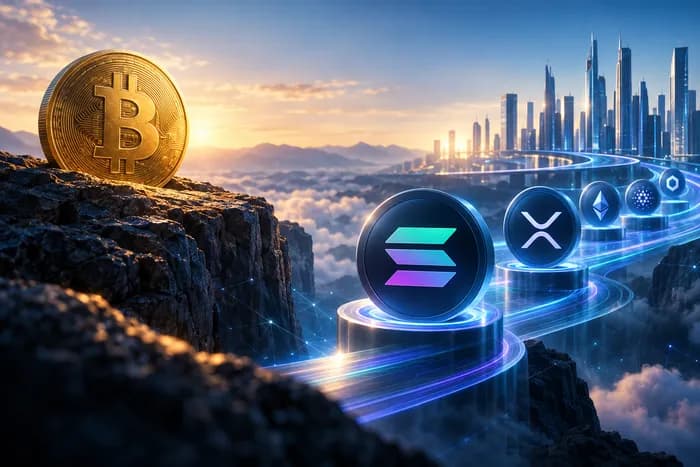
Bitcoin’s Macro Pause Masks Massive Altcoin Tech Upgrades
Bitcoin’s macro-driven consolidation is obscuring major advances in altcoin fundamentals, including the Solana Alpenglow upgrade and XRP Ledger Privy integration. Here is what high-speed blockchain finality and crypto AI payments could mean for investors.
Crypto prices are sending a cautious message, but protocol development tells a more ambitious story. Before the September inflation release on October 14, Bitcoin held above $83,000 and briefly touched $84,000, while the CoinDesk 80 declined 0.6% as traders waited for the data, according to CoinDesk’s October 14 market report.
The release then produced a sharper market reaction. The Bureau of Labor Statistics reported on October 14 that September CPI rose 0.6% month over month and 3.7% year over year, exceeding the 3.6% annual consensus cited before the release. Bitcoin subsequently slipped below $83,000 as investors repriced rate expectations.
That price weakness does not erase what is happening beneath the surface. Solana is preparing a major consensus upgrade, while Ripple and Stripe-owned Privy are building infrastructure for embedded wallets and autonomous payments. The result is a widening divergence between short-term token prices and longer-term altcoin fundamentals.
Bitcoin’s Macro Pause Meets a Hot CPI Print
Liquidity provides the starting point for the macro analysis. CoinDesk’s reported declines in futures volume and open interest were consistent with de-risking ahead of the CPI release. In its October 14 market coverage, CoinDesk reported that 24-hour crypto futures volume had fallen 26% to $156.79 billion, aggregate open interest had declined 2.27% to $140 billion, and roughly two-thirds of CoinDesk 100 constituents were trading lower.
That environment can be particularly restrictive for altcoins. Bitcoin typically retains the deepest liquidity and clearest institutional access during periods of uncertainty. Smaller assets depend more heavily on discretionary capital, leverage, and confidence that monetary conditions will become more supportive. When investors are awaiting inflation data or a Federal Reserve decision, that capital often remains concentrated in Bitcoin, stablecoins, or cash equivalents.
The CPI uncertainty has now become a confirmed inflation challenge. Headline inflation accelerated from 3.4% in August to 3.7% in September, while gasoline accounted for more than half of the monthly increase, according to the October 14 BLS release. A Dow Jones report published on October 14 said money markets raised the probability of an October rate increase from 22% to 49% after the data.
Sygnum Bank investment strategist Can-Luca Köymen consequently identified higher yields and a stronger dollar as Bitcoin’s immediate headwinds. For investors, the implication is straightforward: macro conditions can suppress altcoin valuations even when individual networks are making measurable technical progress.
Why Altcoin Prices and Fundamentals Are Diverging
This is an analytical framework, not a universal rule. A protocol can improve its consensus process, developer tooling, or payment infrastructure without attracting immediate token inflows—especially when Treasury yields, the U.S. dollar, and Federal Reserve expectations dominate portfolio decisions.
Investors should therefore separate market health from protocol health. Market health includes liquidity, volatility, open interest, funding rates, and token-holder positioning. Protocol health includes validator readiness, finality, application activity, fee generation, user retention, and the economic value moving through a network.
This distinction matters because headline activity statistics can mislead. Solana’s upgrade may mechanically reduce reported transactions, while XRP Ledger’s AI-payment count may rise faster than the value transferred. A sound analysis should normalize these metrics before classifying either development as bullish or bearish.
Solana Alpenglow Targets Near-Instant Finality
The Solana Alpenglow upgrade is scheduled for October 21 and targets approximately 150-millisecond finality, according to CoinDesk’s October 14 technology report. The 150-millisecond figure is a target rather than a guaranteed outcome, making post-activation performance essential to monitor.
Blockchain finality is stronger than an initial transaction confirmation. It is the point at which a block can be treated as irreversible. Faster finality could allow merchants to recognize payments sooner, bridges to release assets with less delay, and financial applications to reduce the period during which settlement remains uncertain.
Alpenglow will replace Solana’s existing TowerBFT validator-voting structure. Validators currently submit votes as on-chain transactions, but the new system will move those votes outside ordinary blocks and aggregate approvals into certificates capable of finalizing blocks after one or two voting rounds. That structural change could reduce consensus-related overhead within blocks and make user activity easier to distinguish from validator communication.
The accounting effect is critical. Solana’s reported transaction count may decline sharply after activation because vote transactions will no longer be included, even if application usage remains unchanged. Investors relying on raw transaction totals could mistakenly interpret the decline as deteriorating demand.
Operational execution is another risk. Validators need to run software based on Agave 4.3.0, while Firedancer and Frankendancer operators must temporarily change clients for the initial migration. Investors should watch validator upgrade rates, delinquency, skipped slots, confirmation latency, and realized finality—not merely the advertised benchmark. If the rollout remains on schedule, October 21 will be a technical milestone, not automatic proof that the upgrade has succeeded.
XRP Ledger and Privy Connect Wallets With AI Payments
Ripple’s partnership with Stripe-owned Privy addresses a different infrastructure bottleneck: wallet usability. The XRP Ledger–Privy integration allows developers to embed wallets directly into applications, enabling users or software agents to hold and transfer XRP, RLUSD, and other ledger assets without first installing separate wallet software, according to CoinDesk’s October 14 report.
For embedded Web3 wallets, abstraction is strategically important. Mainstream users may interact with a blockchain-powered product without manually handling seed phrases, switching networks, or opening a conventional crypto checkout. Privy also supports key or recovery-phrase export, preserving an option for users who later want direct control.
The integration is particularly relevant to crypto AI payments. Autonomous agents can be assigned funded wallets and authorized to pay for data, computing resources, or online services. Software could receive a payment request, authorize a small transfer, and access the purchased service without requiring human approval for every transaction.
Reported activity is already substantial by count. AI-driven payments on XRP Ledger have surpassed 14 million, with the underlying dashboard showing more than 14.3 million cumulative transactions across 169 registered merchants in CoinDesk’s October 14 coverage. The available figures should be read as cumulative activity unless a defined measurement period is provided.
However, transaction count should not be confused with economic scale. The cited dashboard recorded cumulative payments of approximately 6,991 XRP and 12,752 RLUSD, indicating that many transfers were micropayments. That pattern is consistent with machine-to-machine commerce, but investors should track payment value, repeat usage, active merchants, and fee economics before concluding that the activity represents mass adoption.
An Investor Framework for the Infrastructure Cycle
The divergence between subdued prices and improving infrastructure creates opportunity, but it does not eliminate execution risk. Investors evaluating these developments should focus on measurable outcomes rather than announcements alone.
For Solana, relevant indicators include realized finality under congestion, validator participation, client stability, application latency, and transaction counts adjusted to exclude historical vote traffic. A successful upgrade should improve settlement quality without weakening decentralization or uptime.
For XRP Ledger, investors should monitor funded embedded wallets, active AI agents, unique paying applications, RLUSD and XRP settlement value, merchant retention, and average payment size. Rapidly rising transaction counts with stagnant value may still demonstrate technical usage, but they offer weaker evidence of durable token demand.
Portfolio construction also matters. Elevated inflation can raise discount rates, strengthen the dollar, and restrict speculative liquidity even when altcoin fundamentals improve. Investors may therefore separate technical milestones from entry timing: a protocol can become healthier before its token becomes attractively priced or begins outperforming Bitcoin.
The strongest signal would be convergence: improving network health combined with rising, economically meaningful usage, deeper liquidity, and sustained demand for the native asset. Until then, development progress should be treated as a leading indicator rather than a guaranteed price catalyst.
Conclusion
Bitcoin’s pre-CPI stability and subsequent post-release weakness occurred as important blockchain infrastructure developments were underway. Solana is attempting to compress finality toward 150 milliseconds while redesigning validator voting, and Ripple is combining XRP Ledger settlement with Privy’s embedded-wallet technology for autonomous payments.
The hotter September inflation report means macro pressure remains the immediate force shaping crypto prices. But investors who look beyond daily candles can see the next competitive phase forming: faster settlement, simpler wallet experiences, and software capable of purchasing services independently. Altcoin prices may be pausing, but the infrastructure race is not.