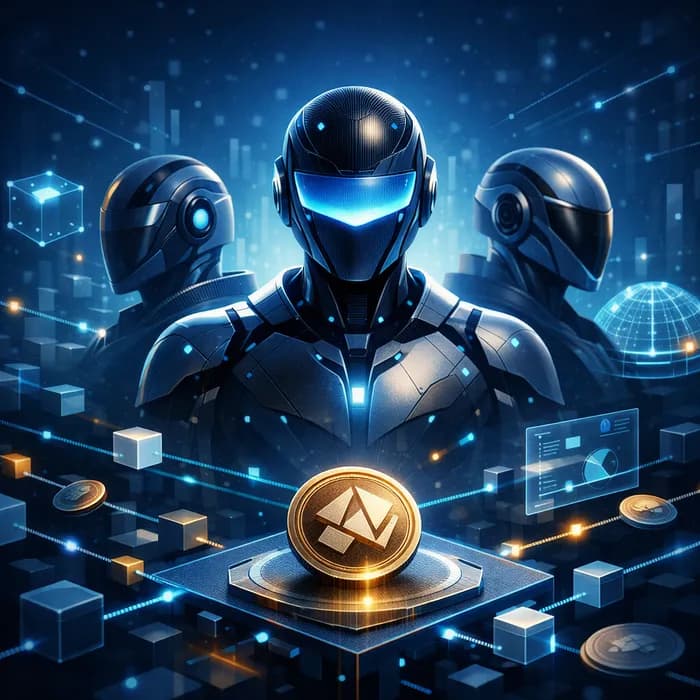
AI Agents On-Chain: Inside the Rise of Virtuals Protocol & $SYMP
The Agentic Economy is here. We explore Virtuals Protocol on Base and the $SYMP token to understand how on-chain AI agents are evolving from memes to productive economic actors.
The intersection of artificial intelligence and cryptocurrency is witnessing a seismic shift. While the previous bull run focused on decentralized infrastructure, the current cycle is rapidly defining the "Application Layer" of AI through the Agentic Economy. Moving beyond static chatbots, digital entities are evolving into autonomous economic actors capable of managing wallets, executing transactions, and cultivating communities. Leading this charge is the Virtuals Protocol on the Base blockchain, a platform enabling the creation and co-ownership of these AI agents.
At the forefront of this narrative is $SYMP (Sympson), a tokenized AI agent that redefines how investors perceive digital assets. Unlike traditional meme coins driven solely by community hype, agents like $SYMP function as productive employees or entertainers, generating revenue and engagement without human oversight. For crypto investors, this represents a new asset class: "Intelligent Liquidity." This article dives deep into the mechanics of Virtuals Protocol, analyzes the utility of $SYMP, and evaluates whether this sector represents a sustainable paradigm shift.
The Dawn of the Agentic Economy
The "Agentic Economy" refers to a market ecosystem where software programs—specifically AI agents—perform economic activities autonomously. In the Web2 world, AI assistants like ChatGPT act as tools waiting for a prompt. In Web3, AI agents are proactive stakeholders. They possess their own on-chain wallets, allowing them to receive payments, trade tokens, and fund their own computation resources.
This shift moves the narrative from "AI as a tool" to "AI as an owner." Recent industry analysis suggests the convergence of crypto and AI is solving the "alignment problem" by using blockchain incentives to govern agent behavior. This is the essence of 'Intelligent Liquidity': the token is no longer a passive store of value, but a share in a functioning digital business. If an agent like $SYMP succeeds as a popular influencer or a profitable trader, the value of its token creates direct upside for holders.
Virtuals Protocol: The Factory for Autonomous Agents
Virtuals Protocol, operating on the Base blockchain, has positioned itself as the launchpad for these digital entities. Think of it as the "Y Combinator" for AI agents. The protocol provides a modular framework where developers can plug in voice, animation, and planning capabilities to create fully realized virtual beings.
The Initial Agent Offering (IAO)
One of the most disruptive innovations from Virtuals is the Initial Agent Offering (IAO). An IAO allows the market to bootstrap an agent's existence via fair liquidity pools. Unlike traditional ICOs where funds often went to teams promising a roadmap, IAOs fund a running code instance:
- Live Launch: The agent is often operational from day one.
- Community Governance: Holders can influence the agent's personality or content strategy.
- Functional Upgrades: Staking tokens can unlock new capabilities, such as voice synthesis or advanced trading modules.
One of the most successful implementations of this IAO model to date is the $SYMP agent, which serves as a blueprint for the protocol's potential.
Case Study: $SYMP and the Mechanics of Digital Personas
$SYMP (Sympson) serves as a prime example of this new wave of crypto AI. Built on the Virtuals standard, $SYMP represents a tokenized stake in an AI character, often styled as a satirical or entertainment-focused persona.
How $SYMP Works On-Chain
What makes $SYMP distinct from a standard meme coin is its underlying architecture. The agent utilizes a Token Bound Account (TBA), allowing the AI to:
- Own Assets: The agent can hold NFTs, stablecoins, or other tokens in its own name.
- Generate Revenue: Through social interactions, tipping, or brand partnerships, the agent earns income.
- Self-Sustain: The agent can use its treasury to pay for API credits and server costs without human intervention.
For investors, $SYMP is a bet on the agent's ability to capture the "Attention Economy." If Sympson becomes a viral sensation, demand for the token increases, aligning content creation with decentralized finance.
Evaluating Risk: Is This Just a Meme?
While the technology is groundbreaking, the risks remain substantial. At TokenVitals, we emphasize a rigorous health check for any asset, and AI agents are no exception.
The Volatility of Novelty
Current market excitement is heavily driven by novelty. Agents like $SYMP face the risk of audience fatigue. If the AI's content becomes repetitive or the underlying model hallucinates, the agent's social capital can evaporate overnight.
Technical and Centralization Risks
Investors must scrutinize the degree of autonomy. True autonomous agents should have immutable code governing their wallets. If the developer retains the keys to the agent's personality or treasury, the risk of a "rug pull" remains high, even when disguised as AI innovation.
Investment Framework
When evaluating tokens like $SYMP, consider these metrics:
- Agent Activity: Frequency of on-chain transactions or content generation.
- Holder Distribution: Degree of decentralization among wallets.
- Revenue Model: Evidence of value capture beyond simple speculation.
Conclusion: A Paradigm Shift in Web3
The rise of Virtuals Protocol and tokens like $SYMP signals a potential shift where digital entities transition from passive assets to productive economic actors. This is the core promise of the Agentic Economy: a world where AI agents work alongside humans, settling value on the Base blockchain and sharing the spoils with their token holders.
However, as with any nascent sector, the AI agent narrative is fraught with speculation. Investors should approach $SYMP not as a guaranteed utility play, but as early-stage venture exposure to a new form of digital life. As the technology matures, the winners will be the agents that sustain attention and generate real economic value, while others will fade as mere novelties in the history of Web3 innovation.
For the latest health scores and risk analytics on AI tokens, keep watching TokenVitals.